Future Aftershocks
I made this meme ages ago, and now it feels less like a joke and more like an accidental insight.
::: captioned-image-container
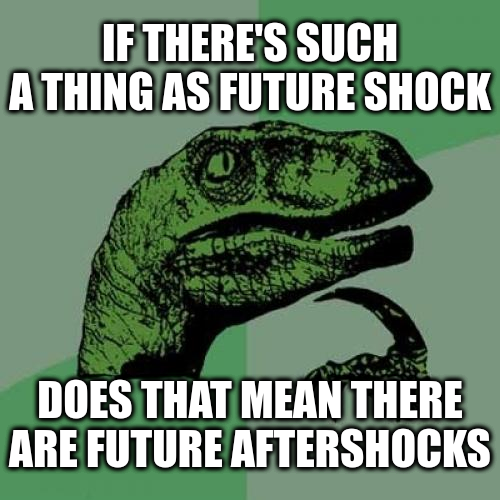


I’ve been digging through my Twitter archives—not out of nostalgia, but as an expedition into the past. When I saw this image, it clicked: Yes. That’s the throughline. Not just a connection from then to now, but a recurring pattern—echoing in both history (big picture) and personal memory (small picture). This is where I should go next.
Future Shock to Future Aftershocks
If you don’t know what Future Shock is, it’s basically the idea that there’s been too much change in too short a time period. This should feel very familiar to most, even if you’ve never heard of the concept before, because it’s as though we’re living through a continual cycle of shock.
This same recursive pattern—whether it’s personal nostalgia, technological cycles, or cultural panic—keeps playing out. I’m not a fan of nostalgia, but I am a fan of history and rumination. It’s the reason I find looking back at old posts, old computers, or old tech trends meaningful: it isn’t just sentimentality, it’s because recognizing past patterns makes current ones easier to decode.
Tech is a perfect example of this ongoing cycle of “disruption,” intentional or otherwise. We get past the initial shock—sometimes with great discomfort or cost—but the aftershocks keep coming. We’re seeing this now with generative AI: the disruption isn’t just the tech itself, but the ripple effects it sets off. But the disruption builds on itself. It changes the change itself. We stack new instability on top of old.
Why did I make this?
We can also look to social media. In going through my Twitter content, it feels like digging through geological strata—layer after layer of past discourse, old whims, and forgotten fascinations. I can see what whims I was chasing at various times, what held my fascination, pick up echoes of discourse past. What’s old is new again because it never really went away. I don’t really use Twitter (or X, if you’re nasty) anymore. But the migration from Twitter to Bluesky? That was an aftershock—just like MySpace to Facebook before it. These shifts always seem sudden, but when they happen, we integrate them and move on—as much as possible, anyway.
I made a lot of “content.” Calling it that feels weird, since I was mostly chasing whimsy, but that’s what it was—and still is. It’s my own content, often for myself, because the way I treated social media was that I am an audience of one and anyone else found it funny, well, they’re welcome to laugh along with me.
::: captioned-image-container

I don’t know why I made a Žižek with boxing gloves meme—nonsense at the time, smashing together Homestar Runner with public intellectual cultural critique is pure personal indulgence humor. Two cultural artifacts with zero overlap—which is exactly what makes it great (to me).
It also kind of works on a deeper level, in the sense that Žižek’s speaking style already has that rambling, disjointed energy, so imagining him trying to type like Strong Bad, angrily slamming at the keyboard with unseen boxing gloves, just fits.
At the time, this was pure nonsense. But now, in an era of AI-generated content and increasingly post-ironic cultural blending, it almost feels… predictive.
It’s not just me, it’s tech
The idea of Future Aftershocks isn’t just about how change ripples forward—it’s about how hindsight clarifies those ripples, making it easier to see that we’re not in some unprecedented moment of disruption. We’re just living in another iteration of a very old script. We’re seeing this now with generative (AI) technologies.
I’m old enough I can remember when FPUs were optional. My first computer was a 486sx. My second was a Pentium 120— pre-MMX. When MMX dropped, I thought it very silly that they were marketing an instruction set as some revolutionary thing. We’re basically at that point now with generative technology. NPUs being added to phones, tablets, laptops.
Unless you’re a Bluesky Butlerian Jihadist, you’re probably either curious about AI or just indifferent to the hype. NPUs are just another coprocessor, the same way FPUs were back in the day—except instead of floating-point math for physics and graphics, they’re optimized for tensor operations, matrix multiplications, and other ML-adjacent calculations. Functionally, it’s not that different from early 3D accelerator cards, either—just hardware specialized for a very specific computational workload that’s been offloaded from the CPU.
What we’re seeing now is the echo of MMX. The main difference? The marketing hype cycle. Back then, no one breathlessly claimed FPUs were the future of computing. They were just a performance boost—eventually absorbed into standard CPU architecture. The same will probably happen with NPUs. Outside of a handful of tasks (voice assistants, photo enhancement, AI upscaling), consumer demand for on-device AI is… limited.
This is funny because it always plays out the same way:
New chip feature gets overhyped
A few actual use cases emerge, but they’re mostly niche
It gets absorbed into standard processor architecture or platform and stops being a selling point.
The new normal is never normal—until it is
Future aftershocks only become visible when you stop and look back. That’s true for culture, and for your own thoughts. I don’t usually archive; I’m not the kind of person who scrapbooks. Going through my Twitter archive, my intent was to mine for content, but it occurred to me how patterns emerged as I went through it. Even through the visual media alone!
The recursive irony is that by writing this, I’m creating another future aftershock. A year or two from now, if I stumble across this post, it’ll probably feel different. I don’t usually dwell on nostalgia, but in this case, it’s not about reliving the past, it’s about understanding the patterns. It’s about understanding myself, in some ways, and the moment I exist in now and the past that brought me here. It helps me to recognize patterns when they come back around.
The past isn’t just nostalgia—it’s a decoder ring for the present and future.
In a few years, I’ll probably stumble across this post and think, “Damn. He had no idea”.