The Death Star Distraction
While everyone was posting about this, LEGO quietly executed a textbook platform enclosure strategy worth $2.5 billion in operating profit.
::: captioned-image-container
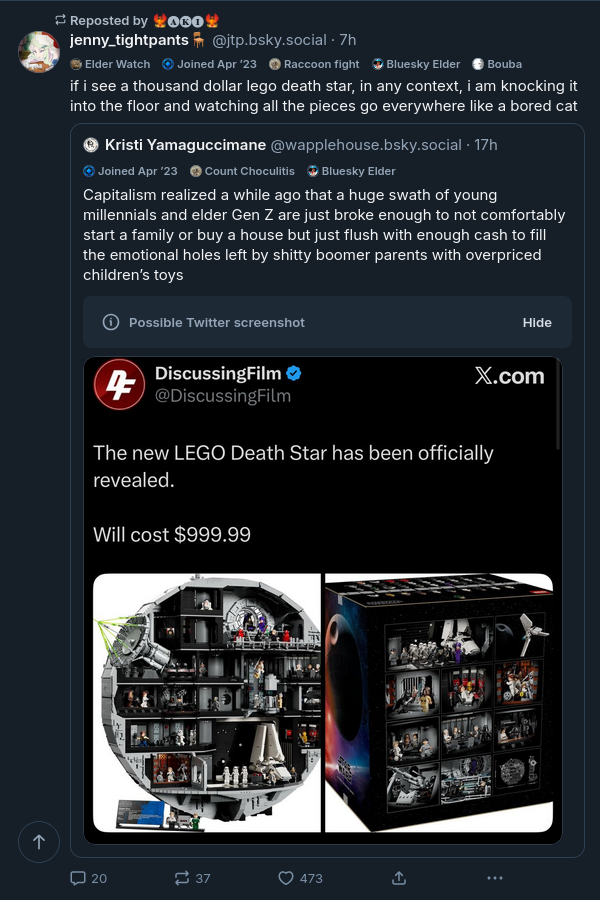


The Shiny Object
The screenshot tells the whole story of how cultural discourse gets hijacked. A $999 LEGO Death Star announcement drops, and immediately the conversation funnels into predictable grooves:
"I am knocking it into the floor and watching all the pieces go everywhere like a bored cat"
"Capitalism realized a while ago that a huge swath of young millennials and elder Gen Z are just broke enough to not comfortably start a family or buy a house but just flush with enough cash to fill the emotional holes left by shitty boomer parents with overpriced children's toys"
Everyone's locked into the consumer discourse layer. Is it too expensive? Are adults buying toys to fill psychological voids? Should we be mad at people for having disposable income? The Death Star becomes what communication researchers call a "hyperpersonal" engagement machine—online discourse that feels more socially rewarding than face-to-face conversation because participants can optimize their self-presentation around cultural critique while idealizing each other's responses.
But here's what's fascinating: while thousands of people performed sophisticated analysis of late capitalism and projected their class anxieties onto plastic bricks, literally nobody was talking about what LEGO was actually doing as a business. The performative outrage was working exactly as intended—a cultural smokescreen for a strategic transformation worth billions.
The Real Story
Six months before the Death Star discourse, I spotted something that should have been a red flag for anyone paying attention to LEGO's actual strategy. They had started embedding proprietary electronics into sets - "Smart Play" bricks that only worked with LEGO's own apps and systems. Not revolutionary on its own, but I called it out as "insidious" because it represented a shift from open play to gated ecosystems.
::: pullquote No, the thing to keep your eye on is Smart Play bricks. :::
While everyone debated whether adults buying LEGO was healthy or pathological, LEGO was quietly executing a textbook platform enclosure move. And they literally spelled it out in their 2023 annual report:
27% more digital hires. This isn't a toy company iterating on products - it's a company building the infrastructure for a digital platform. They're not hiring designers; they're hiring "digital experts" to create proprietary experiences that tie physical products to locked ecosystems.
147 new branded stores in one year. This isn't about selling more bricks - it's about controlling the entire touchpoint ecosystem. Retail becomes an onboarding and retention funnel, straight out of Apple's playbook. The stores aren't just selling products; they're selling platform membership.
Paper instructions being systematically phased out. Framed brilliantly as "sustainability," this is actually mandatory digital adoption disguised as green virtue signaling. If your set only works fully through an app, that's forced platform engagement. Every builder becomes a registered user.
LEGO Insiders membership program expanding globally. This isn't just rewards points - it's data capture and persistent digital identity creation. Once every LEGO fan has a digital ID, the company can create cross-product engagement loops and lifetime customer trajectories that clones can't touch.
The numbers tell the real story: DKK 17.1 billion in operating profit. That's not toy company money - that's platform company money.
Nostalgia as Bait, Not Product
Here's the thing everyone missed: the Death Star isn't the product. It's the lure.
Adult collector sets like the $999 Death Star serve a specific function in LEGO's strategy - they're loss leaders for attention. They generate massive cultural engagement, but not because LEGO expects to sell millions of them. They work because they train the cultural conversation to focus on the wrong layer entirely.
While people argue about whether a $999 toy represents late-stage capitalism or justified luxury spending, LEGO is embedding proprietary electronics into children's play patterns. The Mario sets that only work with LEGO's app. The Smart Play bricks that create hardware lock-in from age 6. The systematic transition from universal building blocks to platform-dependent experiences.
The Death Star discourse is perfect cover because it feels substantive - we're talking about psychology! economics! generational trauma! - while being completely irrelevant to understanding LEGO's actual business transformation. The company gets to execute a strategic pivot toward digital feudalism while everyone debates the emotional validity of adult toy purchases.
It's the same playbook Disney used when they launched Disney+. Generate culture war heat about "adult Disney fans" and nostalgia consumption, while quietly building the subscription infrastructure that transforms the company from content creator to platform controller. The discourse becomes the distraction.
The Pattern
This dynamic plays out everywhere once you learn to see it. While people argue about visible consumer products, companies execute invisible infrastructure changes:
Apple retail stores aren't about selling phones - they're about creating ecosystem onboarding experiences. Tesla Superchargers aren't just charging stations - they're proprietary network lock-in. Amazon's Alexa wasn't about voice assistants - it was about embedding surveillance infrastructure in homes while people debated whether talking to machines was weird.
The cultural discourse always focuses on the psychological or social implications of the consumer product, never the structural business model shift happening underneath. We get trapped in debates about whether the thing is good or bad for us personally, while missing how the thing is changing the rules of the game entirely.
LEGO figured out how to transition from "toy company that adults also buy from" to "lifestyle platform company that happens to make building blocks" while making it look like a discourse about consumerism and childhood nostalgia. Brilliant.
Platform Enclosure Through Play
What makes LEGO's pivot particularly effective is that they're implementing platform control through children's play. The transition from universal, interoperable bricks to Smart Play systems that only work within LEGO's ecosystem mirrors the broader shift from open internet to walled gardens—except it's happening at the developmental level.
When a kid's first building experience requires an app login and creates a persistent digital identity tied to a corporate platform, that's not just play. That's infrastructure for lifetime customer capture.
The genius is that it's nearly impossible to critique without seeming anti-fun. Who argues that kids shouldn't have interactive, digital-enhanced experiences? But alternatives (universal building blocks that work with everything) were more open and generative.
The Wall
By the time you notice the walls, they've already been built. And you were busy arguing about the Death Star.
LEGO's 2023 results prove that the strategy worked. While the culture was locked in discourse about adult toy consumption, the company executed a textbook transformation from product manufacturer to platform controller. The Death Star discourse wasn't a distraction from their business strategy - it was part of it.
The next time you see a viral debate about some expensive consumer product, ask yourself: what's happening while everyone's looking at this? What infrastructure changes are being implemented while we psychoanalyze spending patterns? What platform enclosures are advancing while we debate the cultural significance of the shiny object?
When you see a viral debate about a shiny object, ask what is happening in the shadows cast by its glow. The real game is rarely the one everyone is arguing about.