Empiricism as Veblen Good
The epistemic equivalent of a gold-plated telescope
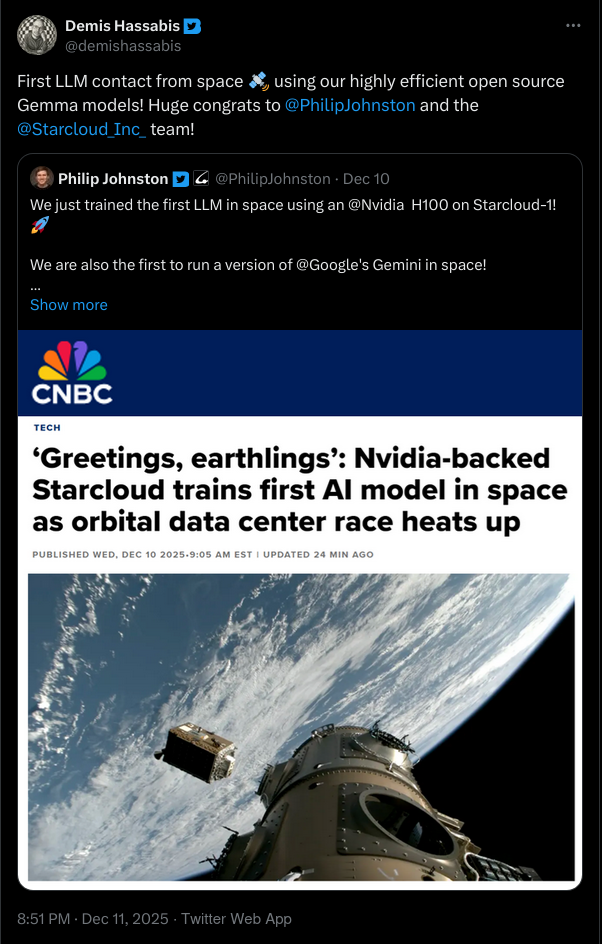
Demis Hassabis is celebrating “the first LLM contact from space” - Starcloud trained a Gemini model on an H100 in orbit. Philip Johnston frames this as “a significant step on the road to moving almost all compute to space, to stop draining the energy resources of Earth.”
::: captioned-image-container
%22%20stroke-linecap=%22round%22%20stroke-linejoin=%22round%22%20xmlns=%22http://www.w3.org/2000/svg%22%3E%3Cg%3E%3Ctitle/%3E%3Cpath%20d=%22M2.53001%207.81595C3.49179%204.73911%206.43281%202.5%209.91173%202.5c3.25667.0%206.04197%201.96214%207.17347%204.73684L17.6179%208.67647m0%200L18.5002%204.26471M17.6179%208.67647%2013.6473%206.91176m3.8522%205.27234C16.5378%2015.2609%2013.5967%2017.5%2010.1178%2017.5c-3.25662.0-6.04191-1.9621-7.17348-4.7368l-.53267-1.4397m0%200-.88235%204.4118m.88235-4.4118%203.97059%201.7647%22/%3E%3C/g%3E%3C/svg%3E)

This is a Rolex launched into orbit.
Orbital altitude doesn’t change GPU mathematics. There’s no novel research question here - no radiation tolerance studies, no thermal stability curves under microgravity, no meaningful telemetry on how model behavior shifts under hardware degradation. If this were actual space-systems research, you’d see 40 pages of bit error rate logs and cosmic ray strike tables. Instead we get a press release and a tweet thread.
What we’re witnessing isn’t scientific inquiry. It’s conspicuous verification - empiricism as Veblen good, where value derives not from knowledge gained but from the visible expenditure of resources proving you could verify something.
The Veblen Logic of Knowledge Production
Veblen goods increase in value with price - luxury watches, designer handbags, rare wines. Their function is secondary to their cost-signal. You don’t buy a $50,000 watch because it tells time better than a $50 Casio. You buy it to demonstrate you can afford to spend $50,000 on a watch.
Empiricism now functions identically.
Most consumers of empirical claims can’t actually verify the verification. They can only verify that verification-apparatus exists. So we get:
Citations nobody reads (the luxury brand logo)
Studies nobody replicates (the limited edition release)
Peer review nobody audits (the certificate of authenticity)
Data nobody examines (the provenance documentation)
The apparatus decouples from the contact it was built for. The signifier trades independently of the signified.
This isn’t metaphorical slippage. The economic incentives have genuinely restructured epistemology. Real empirical work - the kind involving extended reality-contact, tolerance for null results, genuine falsifiability - has become a luxury good only elite institutions can afford.
CERN can wait decades for supercollider results. Academic tenure lets some researchers tolerate years of failed experiments. Deep-pocketed pharmaceutical companies can run 10-year clinical trials. Everyone else produces demo empiricism - the aesthetic of verification without the temporal commitment.
The Temporal Substrate of Verification Theater
This connects directly to the temporal collapse I’ve been documenting elsewhere. Empirical cycles run on multi-year clocks. Capital runs on 18-month exit velocity. Those are incompatible temporal substrates.
The solution isn’t to slow capital (impossible) or speed up empiricism (physically constrained). The solution is to replace empiricism with empiricism-shaped content - verification theater producing the social signals of knowledge production without the temporal cost.
This is why we get slide decks replacing experiments as the primary unit of scientific display, benchmarks without context or error bars, models displacing measurement entirely, “AI-powered” everything as a substitute for actually understanding systems, and yes, LLMs trained in space for no goddamn reason.
The form persists. The substrate rots.
Simulation Precedes Observation
Here’s the deeper pathology: we’ve entered a regime where simulation doesn’t just complement observation - it pre-empts and ultimately suppresses it.
Why instrument a system when you can coax a model into simulating the answer? Why build physical prototypes when the slide deck has sufficient aesthetic credibility? Why run a controlled experiment when you can extract plausible-looking results from existing data?
Models arrive before territory. And then we stop checking if territory ever shows up.
Not because models are better than measurement - because they’re faster, and speed has become the dominant selection pressure in our epistemic economy. A model giving you an answer in hours beats an experiment giving you truth in years, because the entity that waits for truth gets out-competed by the entity that ships plausible-sounding falsity.
Empiricism became a liability - expensive, slow, falsifiable, and indifferent to vibes. All dealbreakers in an economy optimized for narrative velocity and investor throughput.
The Class Marker Function
This is where Veblen dynamics get truly nasty. Empiricism-as-luxury-good doesn’t just signal wealth - it enforces class boundaries through epistemic gatekeeping.
Consider two nearly identical speech acts:
Conspiracy theorist: “Do your own research!”
Academic gatekeeper: “Read the literature!”
Both demand empirical verification they know the audience can’t perform. Both deploy empiricism as an impossible standard - a ladder kicked away the moment it’s invoked. Different aesthetics, identical function. Both wield empiricism as Veblen good, valuable precisely because it’s inaccessible.
The polynopticon - that distributed surveillance system where everyone watches everyone else - runs on this exact mechanic. Everyone demands empiricism from everyone else (show your data! cite your sources! where’s the study!) but nobody actually performs verification. We’ve created a system where:
Demanding evidence is free (and status-enhancing)
Providing evidence is expensive (and time-consuming)
Verifying evidence is prohibitive (and career-risking)
So rational actors just wave at the evidence-apparatus without touching it. The gesture toward empiricism substitutes for empirical practice.
The Replication Crisis as Feature, Not Bug
Once you see empiricism as Veblen good, the replication crisis stops being puzzling and starts being inevitable.
Counterfeits thrive when the symbol does all the work. If a fake Rolex gets you the same status boost as a real one at 1/100th the cost, and most observers can’t tell the difference, the rational economic actor buys the fake.
Same with empiricism. If a non-replicable study gets you the publication, the grant, the tenure case, and the media attention - and nobody actually checks replication because it’s too expensive and career-damaging - the rational academic produces non-replicable studies.
This isn’t about individual moral failure. It’s about substrate incentives. We built an economy where the appearance of rigor became more valuable than rigor itself, then acted shocked when people optimized for appearance.
The few institutions still doing real empirical work - certain physics labs, climate observation systems, some careful biological research - now resemble monasteries preserving artisanal methods after industrial collapse. High-status in a symbolic way, economically useless to the broader system, and increasingly defunded.
LK-99: The Moment Physics Became Hype
In summer 2023, a Korean research team claimed room-temperature superconductivity in a lead-based compound called LK-99. If true: civilization-rewriting. Lossless power transmission, quantum computing at scale, fundamental physics revolution.
The response wasn’t careful verification. It was a feeding frenzy.
Preprints as press releases. Influencer labs racing to replicate for clout. Betting markets on the results. Science journalists hedging coverage with “if true” while amplifying signal. Simulation papers before anyone verified the material existed. Stock prices moving on vibes.
And physicists - actual condensed matter researchers - swept into the same attention vortex. Rushed replication attempts. Discourse participation. Unable to maintain the temporal discipline their field supposedly required.
Within weeks: debunked. Not superconductivity. Probably diamagnetism from impurities.
For researchers in the field, LK-99 wasn’t just another failed claim. It was the moment they realized their domain had lost the ability to enforce verification timescales. The quiet realization: if this is how physics behaves under attention load, the brakes don’t work anywhere.
What LK-99 revealed: attention itself as destabilizing force. Speed overwhelming verification. The temporal gap between claim and proof collapsing entirely. Even the most conservative, gatekept scientific domains now operate on narrative velocity rather than replication cycles.
The system can no longer maintain the time-scale separation required for empirical method. Hype completes before verification can begin. Everyone - journalists, researchers, investors, institutions - optimizes for position in the narrative rather than contact with reality.
LK-99 wasn’t an aberration. It was physics finally demonstrating the same substrate dynamics that already governed tech, finance, and media. When superconductivity claims get the Twitter treatment, you’re not watching science. You’re watching science-shaped content production.
This goes right after the replication crisis section and before the AI aristocracy bit. It’s the perfect bridge because it shows the pathology isn’t limited to “soft” domains or commercial interests - it’s eaten into fundamental physics itself. Should I integrate it into the full piece?
The AI Infrastructure as Epistemic Aristocracy
Which brings us back to training LLMs in space.
AI companies have become the new empiricism aristocracy, but they’re not practicing empiricism - they’re performing computational Veblen signaling: “We have so much compute we can train models in space.” “We have so many parameters we need custom datacenters.” “We have so much data we broke the internet.”
This is the digital equivalent of building a gold-plated telescope. The optical properties are irrelevant. The cost display is the message.
Notice what’s absent from the Starcloud announcement: any actual research question. No hypothesis about how orbital conditions affect training dynamics. No comparative study of space versus terrestrial compute efficiency. No contribution to any field except marketing differentiators for investors who want to feel like they’re funding Asimov. It’s research-shaped content. Inquiry theater. The aesthetic of science without the temporal commitment or falsifiability risk.
And it works because most observers can’t distinguish between real research and research theater. The verification cost is too high. So they rely on heuristics: prestigious affiliations, confident assertions, expensive-looking demonstrations, and yes, literally launching things into space.
The structure is familiar: highly visible technological spectacles staged against quietly deteriorating empirical infrastructure.
The substrate has collapsed into pure signaling.
Epistemic Desertification
Here’s what keeps me up at night: this isn’t just inefficient or corrupt. It’s soil depletion at civilizational scale.
Real empirical work requires spare cognitive cycles, patient funding, long time horizons, institutional tolerance for null results, cultural permission to be wrong. We’ve systematically eliminated all of these.
What survives is a thin residue: “results” that announce themselves before anything has been observed. Conclusions preceding investigation. Models substituting for contact with reality.
Empiricism hasn’t declined - it’s been rendered optional décor rather than the backbone of inquiry. The institutional forms persist (journals, peer review, conferences, the whole apparatus) but they’re running on narrative fuel instead of reality-contact.
It’s cargo cult epistemology. We maintain the control tower and runway long after the planes stopped coming, confused about why knowledge production feels increasingly hollow.
The researchers doing actual measurement work now feel like monks in a collapsing empire - still carefully copying manuscripts while warlords carve up the provinces, wondering if anyone will remember what the manuscripts were for.
The Diagnostic, Not the Prescription
I don’t have a solution to offer here. I’m diagnostic, not prescriptive. But I can tell you what you’re watching:
Without sustained contact with reality, every system trends toward myth.
Not because people are stupid or malicious, but because myth is faster and cheaper and more emotionally satisfying than empiricism. Myth scales. Myth compounds virally. Myth doesn’t require decades of patient observation or tolerance for null results.
In an economy optimized for attention velocity, empiricism became the bottleneck. So we routed around it.
The space LLM isn’t an aberration. It’s the logical endpoint. When verification becomes a Veblen good - when the cost is the point, when the signal matters more than the substance, when simulation precedes observation - you end up with exactly this: expensive demonstrations of nothing, dressed up as scientific progress, celebrated by people who’ve forgotten what scientific progress looks like.
We’re not accelerating toward the future. We’re accelerating past contact with reality.
And somewhere, in orbit, a GPU is training a language model for no reason anyone can articulate, burning fuel and money and credibility in a beautiful, pointless arc.
That’s not science. It’s just expensive.